












How Intercontinental Missiles Find Their Target
Saturday, February 28, 2026, 5 PM



The Math of the Long-Distance Dart
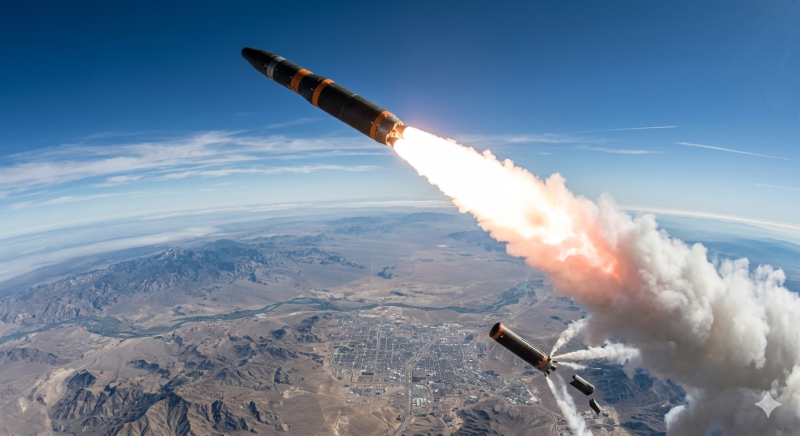
Imagine trying to throw a dart from a moving car in London and hitting a specific coffee cup on a table in Paris. That sounds impossible, right? Yet, ballistic missiles do something even more complex. They travel thousands of miles, leave the atmosphere, and drop back down to hit a target within a few hundred feet. This isn't just luck or a big explosion making up for a miss. It is a series of high-tech "handshakes" between the missile and the laws of physics.
The Inner Ear: Inertial Navigation
The first way a missile stays on track is through something called an Inertial Navigation System (INS). Think of this as the missile's inner ear. Inside, there are sensitive devices called accelerometers and gyroscopes. From the moment the missile leaves the silo, it knows exactly how fast it is going and in which direction it is tilting.
The missile doesn't need GPS for this part. In fact, many don't want to rely on GPS because satellites can be jammed. Instead, the missile does constant math. If it knows it started at Point A and has felt a specific amount of force for a specific amount of time, it knows exactly where it is in the sky. However, over thousands of miles, small errors can creep in. That is where the next layer of tech comes in.
Looking at the Stars
It sounds like something from an old pirate movie, but many long-range missiles use the stars to find their way. Once the missile is high above the clouds and the atmosphere, it uses a small telescope to spot specific stars. This is called celestial navigation.
By comparing the position of the stars to its internal map, the missile can fix any tiny mistakes its "inner ear" made during the bumpy launch. It is a quick check to make sure it is on the right invisible highway before it begins its long fall toward the target.
The Lumpy Earth Problem
Most people think of the Earth as a perfect ball, but it is actually lumpy. Gravity is slightly stronger in some places than others because of mountains or dense rock underground. For a missile falling from space, these tiny changes in gravity can pull it off course.
To fix this, engineers use high-resolution gravity maps. The missile’s computer knows that when it passes over a certain mountain range, it will feel a tiny tug to the left. It pre-calculates these tugs so they don't ruin the aim. It is like a golfer accounting for the wind before they even swing the club.
The Final Handshake: Radar and Terrain Matching
As the missile comes back into the atmosphere, it is moving incredibly fast—sometimes over 15,000 miles per hour. At this speed, even a small gust of wind could push it away from the target. Some modern missiles use "terminal guidance."
- Radar Mapping: The missile sends out pulses to see the ground below.
- Digital Scene Matching: It compares what its sensors see with a saved picture of the target area.
- Control Flaps: It uses small fins or thrusters to make tiny adjustments in the last few seconds.
By the time the missile is in its final descent, it isn't just falling; it is actively steering itself toward a specific set of coordinates. It is the combination of ancient star-gazing and futuristic sensors that allows it to travel across the globe with terrifying precision.






No comments yet